How to Owner-Train a Service Dog in South Carolina: A Step-by-Step Plan
This page explains the law in general terms. It is not legal advice. For a specific situation, contact the agency listed on this site or an attorney.
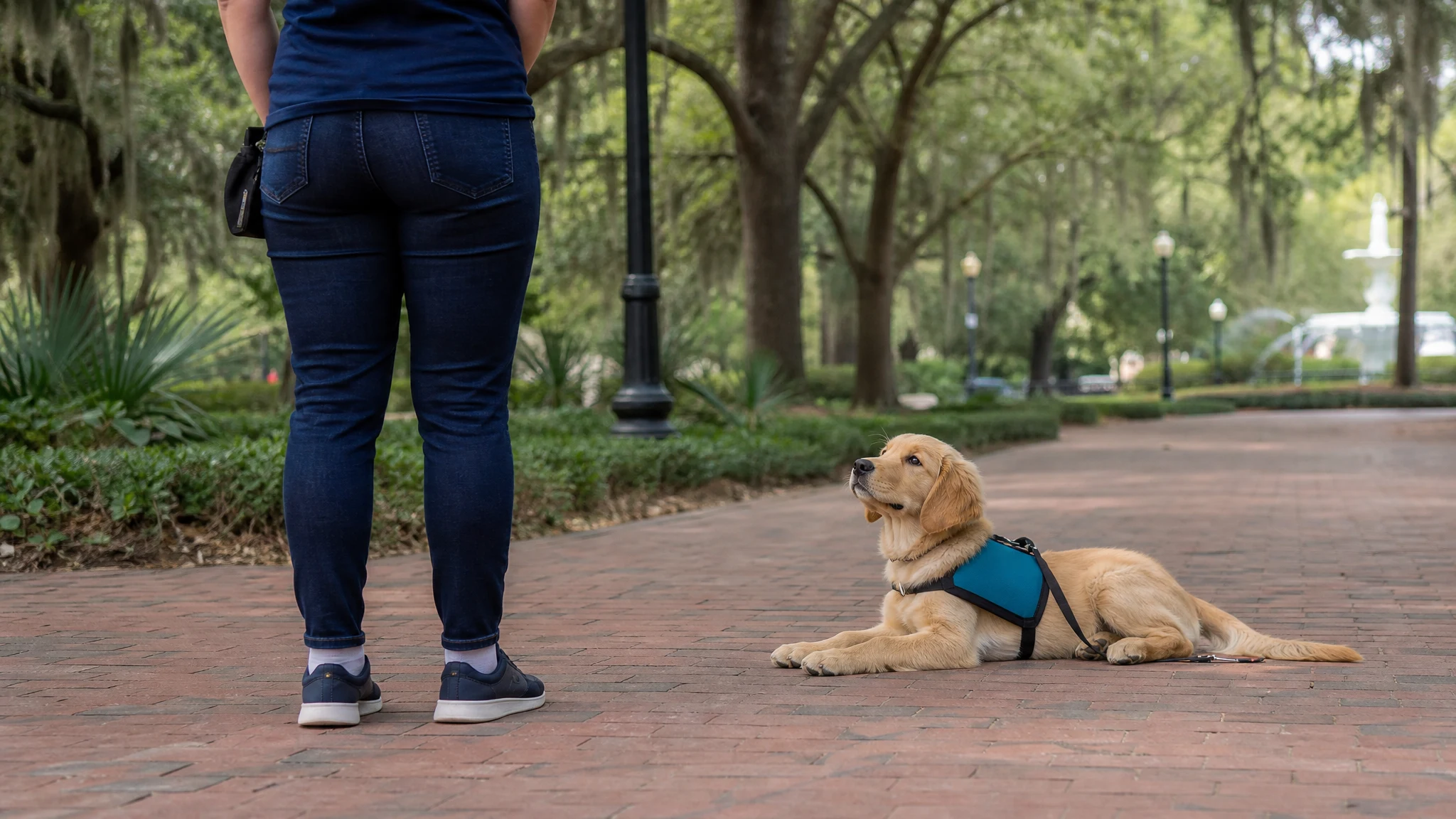
Many people with disabilities want to train their own service dog. It can be done, and the law in South Carolina does not stand in the way. But it is a long project, and it asks a lot of both the person and the dog.
This guide walks through how to train a service dog in five stages: screening, foundation obedience, socialization, task training and public access work. At each stage it explains what South Carolina and federal law say, so you know where you stand. It is not legal advice. It states what the statutes and the ADA say and points you to the agency that handles complaints.
Key Takeaways
- The ADA defines a service animal as a dog individually trained to do work or perform tasks for a person with a disability (ADA.gov Service Animals FAQ). It does not say a program has to do the training.
- There is no official service dog registry or required certification under the ADA. Online registrations and ID cards are not legal proof.
- South Carolina law covers a dog trained or being trained for a person with a disability. Under S.C. Code 47-3-920, the animal must be a dog or a miniature horse.
- Emotional support, comfort and companionship do not count as work or tasks under South Carolina law or the ADA.
- Use humane, reward-based methods. Bring in a professional trainer for task work.
- Lying about a pet being a service animal can bring a civil fine of up to $250, $500 or $1,000, depending on the offense (S.C. Code 47-3-980).
Table of Contents
- What the Law Says Before You Begin
- Stage 1: Temperament and Health Screening
- Stage 2: Foundation Obedience
- Stage 3: Socialization
- Stage 4: Task Training
- Stage 5: Public Access Work
- Support, Programs and Resources in South Carolina
- Sources
What the Law Says Before You Begin
Start with the definitions. They decide whether the dog you are training will have legal protection.
The federal definition
The ADA.gov Service Animals FAQ says a service animal is a dog that has been individually trained to do work or perform tasks for an individual with a disability. The definition looks at what the dog does. It does not require that a particular trainer or program did the training.
The same FAQ describes two questions staff may ask when it is not obvious what the dog does:
- Is the dog a service animal required because of a disability?
- What work or task has the dog been trained to perform?
The South Carolina definition
South Carolina's Layla's Law is found in Title 47, Chapter 3, Article 15 of the S.C. Code (sections 47-3-910 to 47-3-990). Under 47-3-920, a service animal or service animal-in-training is an animal trained, or being trained, to do work or perform tasks for an individual with a disability. That includes physical, sensory, psychiatric, intellectual and other mental disabilities.
The same section limits the term to a dog or a miniature horse. It also says emotional support, comfort or companionship does not count as work or tasks. A dog that only comforts you is a pet or an emotional support animal. It is not a service dog under the ADA, and it falls outside this South Carolina definition.
No registry, no required certificate
The ADA has no official service dog registry and no required certification. The South Carolina statutes read for this guide contain no state ID or registry program either. Do not pay a website for a registration, vest package or certificate and treat it as legal proof. It is not.
If you want to read the full South Carolina rules on access and dogs in training, our companion article on service dog training and access rights in South Carolina goes deeper.
Stage 1: Temperament and Health Screening
Before any training begins, ask two honest questions. Does the dog have the right nature for the job? And do you have a disability for which a trained dog would do work or tasks for you? Under both the ADA and South Carolina law, the dog is trained for an individual with a disability.
Choosing the dog
South Carolina law limits service animals to dogs and miniature horses, so this guide focuses on dogs. Many owner-trainers choose a dog from a breeder, a shelter or their own household. Whatever the source, look for traits that suit public work:
- Calm recovery after a surprise, such as a dropped pan or a slammed door
- Friendly or neutral behavior toward strangers and other dogs
- Interest in working with you and taking food or toy rewards
- A body that can handle the physical work you need, such as bracing or retrieving
Dogs that are fearful, reactive or easily overwhelmed often struggle in public. Washing a dog out of the plan is not a failure. It is part of keeping the dog and the public safe.
Health checks
Ask your veterinarian about general health, vaccinations and any joint or structural concerns that could limit the work. Ask which tasks are physically safe for your dog's body. The statutes do not set a medical checklist, so your veterinarian is the right person to ask about your particular dog.
How the law fits this stage
Article 15 treats a service animal-in-training as falling within the service animal definition. A dog that is not a good candidate will not be able to do the work the definition describes. Screening early protects the time and money you put in. It also protects you from the situation the misrepresentation statute targets, which is passing off an animal that is not a service animal.
Stage 2: Foundation Obedience
Foundation skills come before anything specialized. These are the everyday behaviors that make a dog manageable anywhere.
Core skills to build
- Sit, down, stand and stay, with a reliable release word
- Coming when called, including around distractions
- Loose leash walking beside you without pulling
- Settling on a mat or under a chair for long stretches
- Leaving food and dropped items alone on cue
- Calm handling for grooming, vet exams and gear fitting
Use reward-based methods
Train with treats, toys, praise and play. This approach is in line with the position of the American Veterinary Society of Animal Behavior (AVSAB), which supports reward-based training. Avoid shock collars, prong collars, choke collars, alpha rolls, scruffing and any dominance-based method. They can cause fear and stress, and a frightened dog is a poor candidate for public work.
Keep sessions short, end on a success, and raise difficulty in small steps. Practice at home first, then in the yard, then in quiet places.
How the law fits this stage
South Carolina Code 43-33-20 says a person with an assistance dog is liable for damage the dog causes. Foundation training is your first defense against that. A dog that does not chew, jump or bolt is a dog that does not damage property. It also builds the habits that make later access work possible.
Stage 3: Socialization
Socialization means helping the dog meet the world calmly. It is different from letting the dog greet everyone. A working dog should learn to ignore most people, dogs and distractions.
Build a gradual exposure plan
Introduce new places, surfaces, sounds and people one step at a time. Pay the dog for calm behavior at each step. Good practice items include:
- Slick floors, stairs, elevators and automatic doors
- Shopping carts, wheelchairs, strollers and crutches
- Traffic, sirens, crowds and food smells
- Other dogs at a distance, without greeting
Watch the dog's body language. Yawning, lip licking, turning away and tucked posture are signs to give space and make the next step easier. Never flood a dog with something frightening.
How the law fits this stage
This is the stage where access rules start to matter, because training outings take you into public places. South Carolina Code 43-33-20(d) gives trainers of assistance or guide dogs access rights while engaged in training. Article 15 also places a service animal-in-training inside the service animal definition.
The text read for this guide does not spell out conditions such as the dog's age, a harness or identification. Do not assume them either way. Read the statute yourself, and if you are unsure how it applies to an owner-trainer, ask the South Carolina Human Affairs Commission (SCHAC) before you rely on it.
Article 15 also defines places of public accommodation narrowly. It names airports, train stations, bus stations and establishments defined in 45-9-10. It lets those places set rules for nonservice animals, such as emotional support animals (47-3-990). A business can have its own policy for pets, so keep the dog's behavior excellent and your plans flexible.
Stage 4: Task Training
Task training is what separates a service dog from a well-behaved pet. Under the ADA and South Carolina's 47-3-920, the dog must do work or perform tasks related to the disability. Comfort alone does not qualify.
Choose tasks that match your needs
Tasks depend on the person. Examples of the kind of work a dog may be trained to do include:
- Retrieving dropped items or opening doors for a person with a mobility disability
- Alerting to a sound for a person who is deaf or hard of hearing
- Interrupting a harmful behavior or creating space for a person with a psychiatric disability
- Fetching medication or a phone during a medical emergency
Write each task down with a clear cue, a clear behavior and a clear criterion for success. The second ADA question asks what work or task the dog has been trained to perform. You should be able to answer it in a sentence or two.
Bring in a professional trainer
Owner training is allowed, but task work is the hardest part to do well alone. A qualified professional trainer who uses reward-based methods can help you break each task into steps, spot problems early and keep your dog's stress low. Ask any trainer how they train, and walk away from anyone who uses shock, prong or choke collars or dominance methods.
Check any trainer's claims for yourself. Do not assume a credential or a program is real because a website says so. Ask for references and watch a class before you commit.
How the law fits this stage
A dog in task training is still a service animal-in-training under Article 15, so the same definition applies. If the dog is not learning real tasks, it falls into the emotional support or comfort category. That category does not carry service animal protections under the ADA. South Carolina's Article 15 allows public accommodations to set rules for such animals.
Stage 5: Public Access Work
Public access work is where everything comes together. The dog works calmly in stores, offices, restaurants and transit while you handle the situations that come up.
Build public manners step by step
- Start with quiet, low-traffic outings of a few minutes.
- Practice settling under a table, in a waiting room and in a line.
- Add busier places and longer outings as the dog stays calm.
- Practice tasks in public, not only at home.
- Take breaks and give the dog time to relieve itself and rest.
Stay ready to leave. A dog that is stressed, sick or having a bad day should go home. Removing a dog from a situation is part of good handling.
Know your rights and duties
South Carolina Code 43-33-20 gives a handicapped person the right to be accompanied by an assistance dog in public places and accommodations without extra charge. The person is liable for damage the dog causes. The code uses older terms such as "handicapped person" and "assistance dog," which is why the language in the statute can look different from the ADA.
Under 43-33-40(B), interfering with that access is a misdemeanor. If someone denies you entry, stay calm, answer the two permitted questions and note what happened.
Do not misrepresent your dog. South Carolina Code 47-3-980 makes it unlawful to intentionally misrepresent an animal as a service animal or service animal-in-training to obtain a right or privilege, knowing it is not one. The civil fine is up to $250 for a first offense, up to $500 for a second and up to $1,000 for a third or later. The statute says it is not a criminal offense.
Housing and work
For housing, 43-33-70(d) says a person with an assistance dog has full and equal access to covered housing, without extra compensation for the dog. The person is liable for damage it causes. The South Carolina Fair Housing Law, 31-21-70(G), covers refusal of reasonable accommodations in rules, policies, practices or services.
For employment, the South Carolina Human Affairs Law, 1-13-80(A)(1), makes it unlawful to discriminate in employment because of disability. The text read for this guide has no service-animal-specific employment provision. If you want to bring a service dog to work, ask your employer about a reasonable accommodation in writing, and check with SCHAC about your options.
Where to take a complaint
The agency named for complaints is the South Carolina Human Affairs Commission at schac.sc.gov. Contact it to confirm what kinds of access complaints it takes before you file, since coverage can depend on the type of place and the law involved.
Support, Programs and Resources in South Carolina
Owner-training does not mean going without help. These organizations can be useful to learn from, even if you are not applying for one of their dogs. Check each one directly for current services, costs and waitlists, since those details can change.
- Palmetto Animal Assisted Life Services (PAALS), Columbia. PAALS lists mobility, autism, PTSD, facility dog and skilled home companion work. Its site says it does not charge clients training fees for its dogs, and that its service area is limited by distance. Visit paals.org.
- Service Dogs for Veterans (SD4V), Greenville. SD4V serves veterans and active military. Its site says scholarships cover about 98% of costs. Visit sd4v.org.
- Canine Companions, Southeast Region. Its Southeast page lists South Carolina in its region and says it matches dogs with adults, children and veterans with disabilities at no cost. Its training center is in Orlando, Florida. Check the live page for current details at canine.org.
A note for veterans
The VA Prosthetic and Sensory Aids Service offers a Service Dog Veterinary Health Benefit. The VA does not provide dogs. Its page says the dog must come from an Assistance Dogs International or International Guide Dog Federation accredited program to qualify. Read the eligibility rules on the VA page before you plan around this benefit, because an owner-trained dog may not meet that requirement.
A realistic timeline
No statute or ADA rule sets how long training should take, and no outside deadline decides when your dog is ready. Many owner-trainers spend a long time on each stage. Work at the dog's pace, keep notes on what the dog can do reliably, and be willing to adjust the plan or retire the dog from the work if it is not thriving.
A simple readiness checklist
- The dog performs at least one disability-related task on cue, reliably.
- The dog stays calm and quiet in busy public places.
- The dog does not bother other people, food or merchandise.
- You can answer the two ADA questions in plain words.
- You know the South Carolina rules on access, damage and misrepresentation.
Sources
- ADA.gov Service Animals FAQ
- South Carolina Code of Laws, Title 47, Chapter 3 (Layla's Law, 47-3-910 to 47-3-990)
- South Carolina Code of Laws, Title 43, Chapter 33 (43-33-20, 43-33-40, 43-33-70)
- South Carolina Code of Laws, Title 31, Chapter 21 (Fair Housing Law)
- South Carolina Code of Laws, Title 1, Chapter 13 (Human Affairs Law)
- South Carolina Human Affairs Commission
- VA Prosthetic and Sensory Aids Service: Service Dog Veterinary Health Benefit
- Palmetto Animal Assisted Life Services
- Service Dogs for Veterans
- Canine Companions Southeast Region