Service Dog Tasks and the Public Access Test, Explained
This page explains the law in general terms. It is not legal advice. For a specific situation, contact the agency listed on this site or an attorney.
Two ideas cause most of the confusion about service dogs: what counts as a task, and what a public access test is for. This guide walks through both, step by step, with South Carolina law in view.
It explains how to identify and document tasks for a dog, and how to use a public access test as a training benchmark. It is general information, not legal advice.
The short version
- The ADA.gov Service Animals FAQ defines a service animal as a dog that has been individually trained to do work or perform tasks for an individual with a disability.
- The work or task must be tied to the person's disability. Comfort alone does not qualify.
- The public access test is a training benchmark, associated with the Assistance Dogs International (ADI) standard. The ADA does not require a dog to pass it.
- There is no official service dog registry or required certification under the ADA.
Materials you will need
You do not need to buy special equipment to understand tasks or to practice for a public access test. These items help:
- A notebook or phone notes app to log tasks, dates and results.
- Small, soft treats your dog already likes, plus a favorite toy for reward.
- A flat collar or well-fitted harness and a standard leash. Use gear that does not cause pain or fear.
- A mat or blanket for settle practice.
- A trusted helper who can play the part of a stranger, a shopper or a passerby.
- A list of calm, low-traffic places to practice, such as a quiet store at off-peak hours, with the owner's permission where needed.
Training should be humane and reward-based, in line with the American Veterinary Society of Animal Behavior (AVSAB). Do not use shock, prong or choke collars, alpha rolls, scruffing or dominance methods.
Step 1: Learn what counts as a task
The ADA.gov Service Animals FAQ describes a service animal as a dog individually trained to do work or perform tasks for a person with a disability. The key idea is that the training is individual and the work relates directly to the disability.
South Carolina uses a similar idea. Under South Carolina Code 47-3-920, a service animal or service animal-in-training is an animal trained or being trained to do work or perform tasks for an individual with a disability. That includes physical, sensory, psychiatric, intellectual or other mental disabilities. The state definition is limited to a dog or a miniature horse.
Both definitions rest on the same test. Ask what the dog does, on cue or in response to a specific trigger, that helps with the person's disability.
Step 2: Match tasks to the disability
Tasks differ widely because disabilities differ widely. The examples below show the kind of work that is commonly trained. They are illustrations, not a complete or official list, and each dog's tasks should fit its handler's needs.
Mobility and physical disabilities
- Retrieving dropped items.
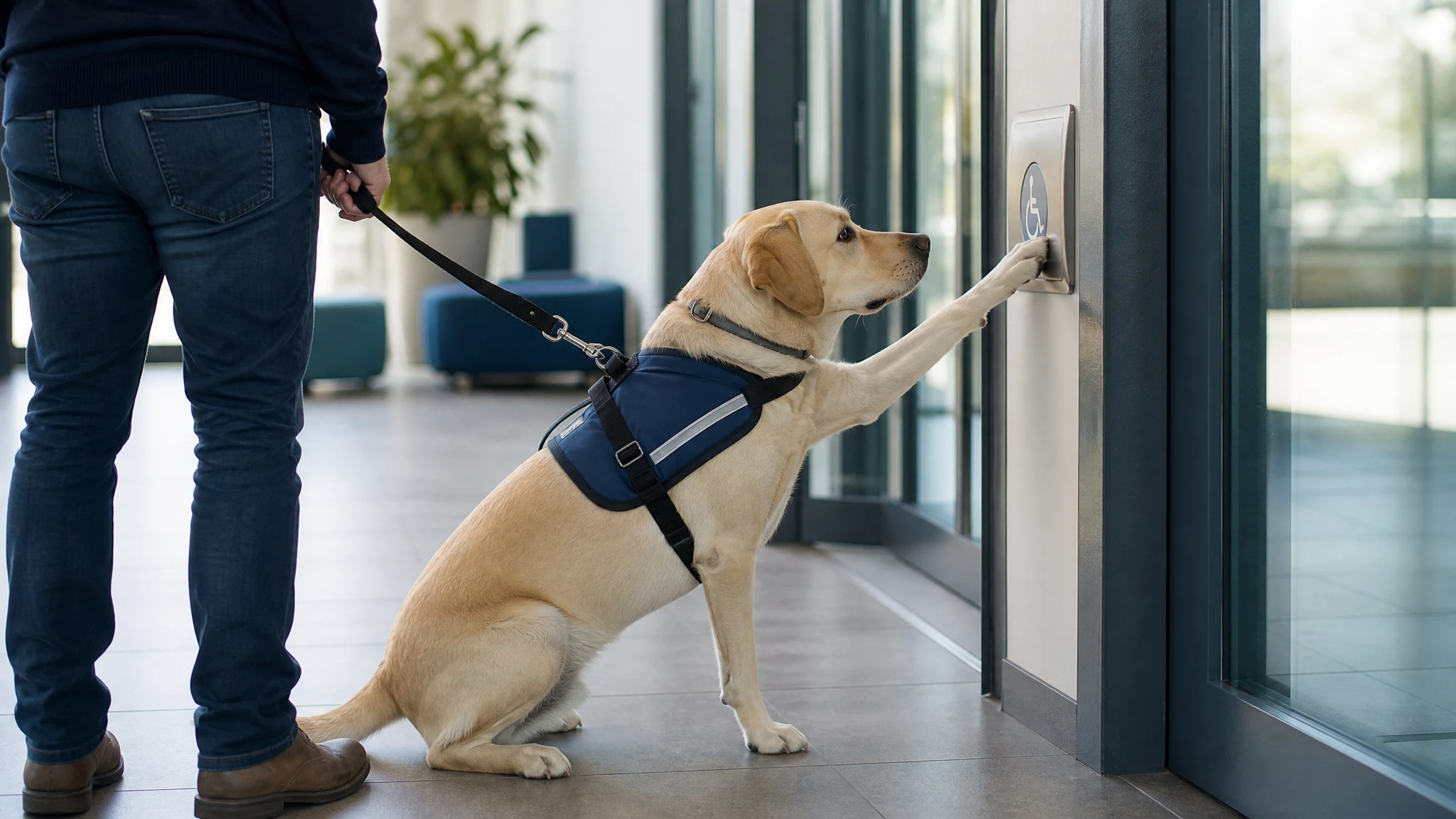
- Opening and closing doors or drawers with a pull strap.
- Providing counterbalance or bracing when trained to do so safely for the handler and the dog.
- Turning light switches on and off.
Vision and hearing disabilities
- Guiding a handler around obstacles.
- Alerting a handler to a sound such as a smoke alarm, a knock or a name being called.
Medical conditions
- Alerting to a change linked to a medical event, when the dog has been trained to do so.
- Fetching medication or a phone.
- Staying with a person and getting help during an episode.
Psychiatric disabilities, including PTSD
- Interrupting a harmful repetitive behavior.
- Waking a handler from a nightmare.
- Creating space in a crowd by standing or positioning on cue.
- Turning on lights or checking a room on cue.
Autism and other developmental or intellectual disabilities
- Interrupting a repetitive behavior when trained to do so.
- Providing a steady, trained response to help a handler stay safe in public.
This answers a common question: what tasks can a service dog do? The honest answer is that there is no fixed list. A task qualifies when the dog is trained to do it and it relates directly to the handler's disability.
Step 3: Understand why comfort alone is not a task
Emotional support, therapy and comfort animals are not service animals under the ADA. A dog's calming presence, affection or companionship is not work or a task in the legal sense, even if it matters a great deal to its owner.
South Carolina draws the same line. Under 47-3-920, emotional support, comfort or companionship does not count as work or tasks. The state law also lets places of public accommodation set rules for nonservice animals, such as emotional support animals (47-3-990).
This is not a judgment about the value of those animals. It is a question of which legal protections apply. A trained response, such as nudging a person out of a panic episode on cue, is a task. Simply being present and comforting is not.
Step 4: Write down each task and how the dog learned it
The ADA does not require paperwork to prove a dog is a service dog. Records still help you train well and stay consistent.
- List each task by name, such as "retrieve dropped items."
- Note the cue or trigger. For example, a spoken word, a hand signal, or a specific event like an alarm.
- Record the date you started training and how the behavior has progressed.
- Note the settings where the dog does the task reliably, and where it still struggles.
Being able to say clearly what your dog does is useful. It lines up with the second of the two questions staff may ask under the ADA.
Step 5: Know the two questions staff may ask
The ADA.gov Service Animals FAQ says that when it is not obvious what a dog does, staff may ask two questions:
- Is the dog a service animal required because of a disability?
- What work or task has the dog been trained to perform?
Practice a short, calm answer to the second question that names a task. You do not need to explain your diagnosis. A dog that has been trained to do specific tasks gives you something concrete to say.
Step 6: Use the public access test as a training benchmark
A service dog public access test is a structured check of how a dog behaves in public. Assistance Dogs International (ADI) is the group most often associated with the standard. Many training programs and handlers use a public access test to see whether a dog is ready to work around crowds, noise and distractions.
Importantly, the ADA does not require a dog to pass any public access test. Under the ADA, the legal question is whether the dog is individually trained to do work or tasks for a person with a disability. A test result is not a legal requirement and is not a license. Check ADI directly for the current text of its standard, because versions and program rules can change.
Even so, the behaviors a public access test looks at are useful to practice. Broadly, they cover how a dog behaves in public:
- Staying calm and under control around people, other dogs, food and noise.
- Walking beside the handler without pulling or lunging.
- Settling quietly when the handler stops, sits or is at a table.
- Responding to known cues even with distractions.
- Staying clean and well groomed, and not toileting in inappropriate places.
Step 7: Practice in small stages
Build skills gradually. Rushing is one of the most common reasons dogs struggle in public.
- Start at home. Teach each cue in a quiet room with no distractions. Reward the behavior you want, right away.
- Add mild distractions. Try a dropped item, a visitor at the door, or a rolling chair, one at a time.
- Move outside. Practice in your yard or on a quiet sidewalk. Keep sessions short.
- Try easy public places. Visit quiet spots at off-peak hours. Leave before the dog is tired or stressed.
- Increase difficulty slowly. Add busier times, more people and longer stays as the dog stays calm.
- Rehearse the benchmark skills. Have your helper walk past with a cart, drop a pan, or pass close by while your dog settles.
If your dog shows fear, stress or avoidance, go back a step. A dog that is uncomfortable in public is not a good fit for public work, and that is a welfare concern, not a failure of effort.
Step 8: Know the South Carolina rules around access
South Carolina law gives access rights to people with disabilities who use assistance dogs. Title 43, Chapter 33 of the South Carolina Code (43-33-20) gives a handicapped person the right to be accompanied by an assistance dog in public places and accommodations without extra charge. The person is liable for damage the dog causes.
For dogs still in training, 43-33-20(d) gives trainers of assistance or guide dogs access rights while engaged in training. The exact conditions are not spelled out here, so read the statute itself or check with the South Carolina Human Affairs Commission. For a fuller look at this topic, see our guide on service dogs in South Carolina, training and access rights.
Layla's Law (Title 47, Chapter 3, Article 15) also sets out a penalty for misrepresentation. Under 47-3-980, it is unlawful to intentionally misrepresent an animal as a service animal or service animal-in-training to obtain a right or privilege, knowing it is not one. The civil fine is up to $250 for a first offense, up to $500 for a second, and up to $1,000 for a third or later offense. The statute says this is not a criminal offense.
No South Carolina ID or registry provision turned up in the text of Article 15. Under the ADA there is no official registry or required certification. An online registration or ID card is not legal proof that a dog is a service dog.
Tips for better results
- Train the task first, then the setting. A dog should do a task reliably at home before you ask for it in a store.
- Keep sessions short and upbeat. Five to ten minutes with clear rewards usually works better than a long, tiring session.
- Reward calm behavior. Pay attention to the moments your dog settles on its own, and mark them.
- Watch body language. Yawning, lip licking, turning away and a tucked tail can signal stress.
- Plan the dog's breaks. Water, relief time and rest matter for a working dog.
- Work with a qualified trainer if you can. Choose someone who uses reward-based methods.
Common mistakes to avoid
- Calling comfort a task. Being calming, affectionate or present does not count as a task under the ADA or under South Carolina Code 47-3-920.
- Treating a test as a legal requirement. Passing a public access test does not create legal status, and not taking one does not remove it.
- Paying for a registry or certificate. There is no official registry or required certification under the ADA, and these products do not prove anything legally.
- Going too fast. Jumping straight to crowded places can create fear that is hard to undo.
- Using harsh tools or corrections. Shock, prong or choke collars and dominance methods go against AVSAB guidance and can harm the dog's trust and behavior.
- Skipping the task log. Without notes, it is hard to see progress or spot a task that is not reliable yet.
What to expect
With steady, reward-based practice, many dogs can become more reliable at their tasks and calmer in public over time. How long this takes varies a lot by dog, by the tasks involved and by the handler's training experience, so no timeline can be promised.
A public access test may help you see where your dog is strong and where it needs more work. It does not guarantee how the dog will behave in every setting, and it does not decide legal rights. Some dogs turn out not to be suited to public work, and that is a normal outcome of careful training.
If you have an access problem
If a business or housing provider denies access, the South Carolina Human Affairs Commission (SCHAC) is the state agency to contact. Its coverage of disability access complaints about service dogs may depend on the setting, so confirm with SCHAC directly what it can accept. The ADA.gov Service Animals FAQ is the federal reference for the ADA rules.
Under 43-33-40(B), interference with access is a misdemeanor. For questions about a specific situation, check with the agency or speak with a licensed attorney.